
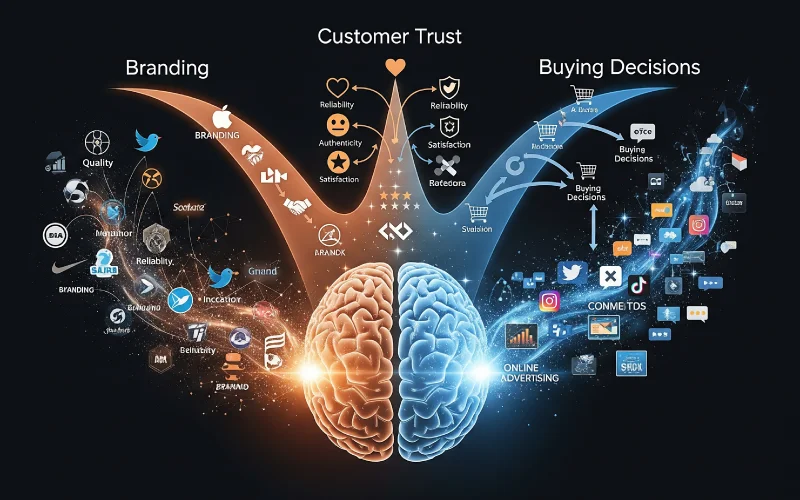
How Branding and Online Advertising Shape Customer Trust and Buying Decisions
Every business wants its audience to trust it. However, given the evolving nature of online marketing and advertising, the path of turning strangers into loyal customers is not a straightforward one.
In 2026 and beyond, the online marketplace will become increasingly saturated with customers being exposed to 10,000 brand messages every single day. With that much exposure, the deciding factor for a customer to purchase a product is TRUST.
Research shows that most consumers need a high level of trust in a brand when considering a purchase. Additionally, consumers stay loyal to brands they trust and are even willing to pay more for this sense of security.
Wondering how this trust and sense of security are built through a strong brand identity and strategic online advertising. Discover more details below.
How Branding Shapes Trust
The concept of branding is mistakenly thought of as simply a logo or a colour scheme. The truth is that branding is the heart of your company, and that perceived value and reputation, which is in the mind of the consumer.
Familiarity and Recognition Trust
Human beings are biologically set to love familiarity. Approximately 60% of consumers would like to purchase brands that feel familiar. A well-known brand is a shortcut to the mind; if a customer is aware of your visual image, they perceive less risk.
This is why consistency is crucial. Brands that maintain consistency on social media, websites, and physical stores witness a revenue increase of 10-20%.
Emotional Relationship and Value
In 2026, features are as insignificant as vibe and values. Most consumers (76%) want to purchase brands they feel connected to.
Contemporary customers identify themselves with companies that reflect their personal values regarding sustainability, ethical work, and social responsibility. A brand that represents more than profit will create a shield of loyalty that is difficult to break.
Credibility and Professionalism
An excellent brand image is an indication of a stable company. For a local business looking to grow, working with a digital marketing agency will allow the company to bridge the divide between small business and the mindset of a recognised leader in the industry.
Professional branding creates the first impression of authority in just 50 milliseconds.
The Way Online Advertising Turns Trust Into Action
Online advertising forms the engine that drives the message home in case branding is the base. It does not merely sell, it engages, educates, and delivers the value of your brand.
The Decision Driver of Social Proof
Social proof– user-generated content (UGC), reviews, and testimonials are the strongest forms of advertising, as 80% of consumers base their purchasing decisions on social proof. Online advertisements that showcase real-life performance or celebrity sponsorships leverage existing trust to overcome consumer distrust.
Precision and Relevance (PPC)
Irrelevant, intrusive advertisements are the worst thing that can destroy trust. In contrast, highly targeted advertisements can enhance credibility by highlighting the most relevant benefits to customers when they need them the most.
When the user searches for a solution and your advertisement provides the flawless solution to the problem, the ad's relevancy serves as a trust signal.
Impact and Interactive Interaction
Humans are visual creatures. 90% of the original judgment a consumer makes before purchasing a product is based on its colour and packaging. Current internet advertising utilizes high-fidelity video and interactive components to make brands feel more human.
Unlike traditional one-way ads, online platforms enable two-way communication, allowing brands to answer questions in real-time and build a community.
How To Bridge the Trust Gap
The best companies in 2026 treat branding and advertising as one integrated strategy; rather than as separate functions, bridging the Trust Gap.
Trust-Building Mechanism And The Way They Work
Transparency
Opting to display supply chains, data privacy, and fair pricing through ads.
Decision Simplification
Applying an established brand name to cut down on choice paralysis in a saturated market.
Employee Advocacy
Incorporating real employees in advertising campaigns (believable 3 times more than corporate communications).
The consumers are seeking authenticity as traditional trust signals (such as high-budget TV spots) are diminishing. Indeed, 86% of consumers cite authenticity as the main factor that drives support for a particular brand.
The Post-Purchase Trust Loop
In 2026, 86% of customers reported that the post-purchase experience is the most vital factor when deciding to repurchase a brand. Trust is earned quickly, but any shipping delays and poor customer service can even undermine even the most carefully planned branding and PPC efforts.
Openness in Logistics
Advertise, not only to sell, but to inform. Strong credibility is built through post-purchase retargeting, which shows customers how to use the new product or provides them with an update on its status.
Signal Hassle-Free Returns
It has been found that 90% of customers will repurchase when the internal complications of the return are simple. Brands should feature messages like “Free” and “Easy Returns” in the ad headline, which immediately ease customers’ concerns.
Key Drivers for 2026 and Beyond
Three pillars, as we see the future of consumer behaviour, include:
Authenticity vs. Perfection: Backstage material tends to perform better than slick advertisements since it feels authentic.
Hyper-Localisation: Customers are seeking opportunities to patronise local professionals. Hiring the services of an SEO Agency in Vaughan helps brands leverage local culture and community ideals.
Sustainability: Today, buyers choose products that align with the environmental footprint. Being transparent about your sustainable practices in advertising is no longer a choice, but a competitive requirement.
Conclusion
Online advertising and branding go hand-in-hand. Branding develops the promise, and advertising provides the proof. Consistency, emotional attachment, and relevancy are key factors that can help businesses build trust with their audience and foster long-term customer relationships.
With such a great amount of choice these days, the brand that is most successful is not the one with the most vocal eyesight but the most reputable to be trusted.
.webp)